
Welding Technology
Quick Facts
- Pathway: Business & Industry
- Campus:
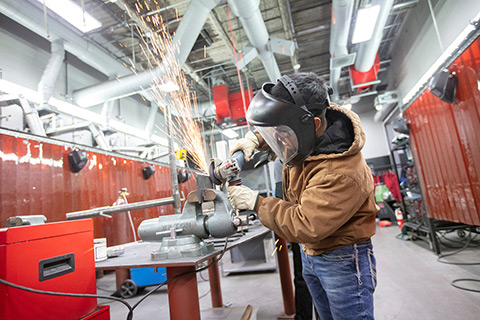
Welding technology involves melting and binding metals to create products, structures, or machinery.
Request Info About TCC
Fill out the form to receive more information about Tarrant County College.
Explore on This Page
Program Description
Why Choose Welding Technology?
- Enter a high-demand field—we need welders who can help rebuild bridges, highways & buildings as the country’s infrastructure ages
- Learn major welding types & industry skills:
- Pipe welding
- Shielded metal arc welding
- Gas tungsten arc welding
- Gas metal arc welding
- Flux cored arc welding
- Plasma & oxyfuel cutting
- Blueprint reading for welders
- Structural plate & pipe layout
- Specialize in a manufacturing sector that interests you, for example:
- Construction
- Machinery
- Shipbuilding
- Automobile manufacturing
- Aerospace projects
- Prepare for entry-level jobs in production welding or supervisory positions
Prepare for What You Will Do at Work
- Join metal components in flat, vertical, or overhead positions
- Buff, grind, cut, or bend edges of pieces you are going to solder to make sure the fit is snug
- Examine your work & rework defective or broken parts
- Use safe work habits when operating welding equipment
Marketable Skills You Will Learn
- Critical thinking
- Reasoning
- Communication
- Personal and social responsibility
- Teamwork
- Computer literacy
Before You Enroll, Think About:
On the job as a welder, you:
- May work outdoors on scaffolds or indoors in confined areas
- May have to move or lift heavy objects
- Must follow all safety procedures to protect yourself from the risks of heat, intense light, gases, and fine particles in the air that result from welding
Need a boost to get ready for college?
Talk to your advisor about Developmental Studies if your TSI scores say you need some help in math or reading and writing.
Degrees & Certificates
Explore the TCC Catalog and view the list of courses you will need to take for your degree or certificate.
Degree
Prepares you to work as a welding technician who understands weld inspection processes and who is qualified to enter a supervisory position.
Certificates
Level 1
Prepare you to work in entry-level jobs in production welding.
How Much Time & Money to Finish?
2026–2027 Academic Year
| Degree or Certificate | Program Title | Semester Credit Hours | Total Tuition & Fees |
|---|---|---|---|
| AAS | Welding Technology | 60 | $4,440 |
| CRT1 | Welding—Basic | 22 | $1,628 |
| CRT1 | Welding—Advanced | 20 | $1,480 |
Notes:
- Tuition is based on in-state, in-county rates.
- Totals do not include textbooks and other materials.
Continuing Education Programs
Time commitments and fees vary depending on the course.
Plan Your Transfer
Transfer to a college or university to continue your studies. Earning a bachelor’s degree opens the door to career and promotion opportunities.
Next steps
- Talk to your advisor about planning for transfer
- Explore transfer schools
Start on Your Pathway!
Contact
Career Advising
Get help with academic planning.
Updated September 29, 2026